Product Description
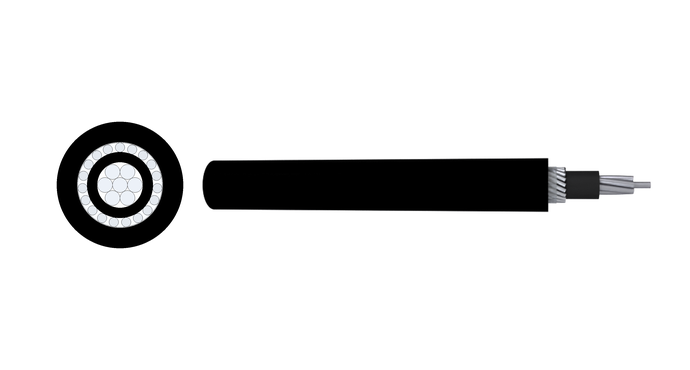
Made of hard-drawn, round aluminum-clad steel wires for general electrical use. Available in conductivity levels of 14%, 20.3%, 27%, 35%, and 40%.
Application
ACS (Aluminum-Clad Steel) conductor is used as an overhead ground wire to protect transmission lines from lightning. It is widely used in Optical Ground Wire (OPGW), steel-reinforced phase conductors, and helical fittings for overhead lines due to its strength and corrosion resistance.
Applicable Standard
ASTM B416,AS/NZS1222.2
Construction
Technical Parameters
| Size | Nominal Cross Section |
No./Wire Diameter | Nominal Diameler |
Approx.Weight | Min.Rated Breaking Strength | Max.Resistance at 20℃ |
|
| No. | Nom. Diameter | ||||||
| mm | no. | mm | mm | kg/km | kN | Q/km | |
| 37x5AWG | 620.58 | 37 | 4.620 | 32.26 | 4169.8 | 635.42 | 0.1393 |
| 37x6AWG | 492.19 | 37 | 4.115 | 28.70 | 3306.7 | 534.86 | 0.1757 |
| 37×7AWG | 390.32 | 37 | 3.665 | 25.65 | 2622.1 | 448.09 | 0.2216 |
| 37×8AWG | 309.55 | 37 | 3.264 | 22.83 | 2080.4 | 374.67 | 0.2794 |
| 37×9AWG | 245.48 | 37 | 2.906 | 20.35 | 1648.9 | 297.11 | 0.3524 |
| 37×10AWG | 194.64 | 37 | 2.588 | 18.11 | 1308.1 | 235.61 | 0.4442 |
| 19×5 AWG | 318.71 | 19 | 4.620 | 23.11 | 2128.1 | 326.39 | 0.2698 |
| 19×6AWG | 252.71 | 19 | 4.115 | 20.57 | 16876 | 274.55 | 0.3402 |
| 19×7AWG | 200.45 | 19 | 3.665 | 18.31 | 1338.6 | 230.18 | 0.4292 |
| 19×8AWG | 158.97 | 19 | 3.264 | 16.31 | 1061.8 | 192.41 | 0.5410 |
| 19×9AWG | 126.06 | 19 | 2.906 | 14.53 | 842.0 | 152.58 | 0.6821 |
| 19x×10 AWG | 99.94 | 19 | 2.588 | 12.93 | 667.7 | 120.99 | 0.8603 |
| 7×5AWG | 117.42 | 7 | 4.620 | 13.87 | 781.1 | 120.28 | 0.7428 |
| 7x6AWG | 93.10 | 7 | 4.115 | 12.34 | 619.5 | 101.14 | 0.9197 |
| 7x7AWG | 73.87 | 7 | 3.665 | 11.00 | 491.1 | 84.81 | 1.1598 |
| 7x8AWG | 58.56 | 7 | 3.264 | 9.78 | 389.6 | 70.88 | 1.4627 |
| 7×9AWG | 46.44 | 7 | 2.906 | 8.71 | 308.9 | 56.20 | 18443 |
| 7×10AWG | 36.83 | 7 | 2.588 | 7.77 | 245.1 | 44.59 | 2.3256 |
| 7x11AWG | 29.18 | 7 | 2.304 | 6.91 | 194.4 | 35.35 | 2.9326 |
| 7×1 AWG | 23.16 | 7 | 2.052 | 6.15 | 154.2 | 28.04 | 3.6977 |
| 3×5AWG | 50.32 | 3 | 4.620 | 9.96 | 334.1 | 54.42 | 1.6986 |
| 3×6AWG | 39.90 | 3 | 4.115 | 8.86 | 265.0 | 45.74 | 2.1418 |
| 3×7AWG | 31.65 | 3 | 3.665 | 790 | 210.1 | 38.36 | 2.7009 |
| 3×8AWG | 25.10 | 3 | 3.264 | 704 | 166.7 | 32.06 | 3.4057 |
| 3×9AWG | 19.90 | 3 | 2.906 | 6.27 | 132.2 | 25.43 | 4.2948 |
| 3×10AWG | 15.78 | 3 | 2.588 | 5.59 | 104.8 | 20.17 | 5.4169 |
| Wire No.and Wire Diameter |
Approx.Overall Diameter |
Cross-Sectional Area |
Approx.Mass per km |
Calculated Breaking Load(CBL) |
Equivalent Aluminum Area |
Direct Current Resistance at 20℃ |
| mm | mm | mm2 | kg | kN | mm2 | Ω |
| 3/2.75 | 5.93 | 17.82 | 118 | 22.7 | 5.9 | 4.80 |
| 3/3.00 | 6.47 | 21.21 | 141 | 27.0 | 70 | 4.02 |
| 3/3.25 | 700 | 24.89 | 165 | 31.6 | 8.3 | 3.42 |
| 3/3.75 | 8.08 | 33.12 | 220 | 39.3 | 11.0 | 2.58 |
| 7/2.75 | 8.25 | 41.58 | 277 | 50.1 | 13.7 | 2.06 |
| 7/3.00 | 9.00 | 49.48 | 330 | 59.7 | 16.3 | 1.73 |
| 7/3.25 | 9.75 | 58.07 | 387 | 69.9 | 19.2 | 1.47 |
| 7/3.75 | 11.30 | 77.28 | 515 | 86.9 | 25.5 | 1.11 |
| 7/4.25 | 12.80 | 99.33 | 662 | 105.0 | 32.8 | 0.864 |
| 19/2.75 | 13.80 | 112.9 | 755 | 136.0 | 37.1 | 0.764 |
| 19/3.00 | 15.00 | 134.3 | 899 | 162.0 | 44.1 | 0.642 |
| 19/3.25 | 16.30 | 1576 | 1060 | 189.0 | 51.8 | 0.545 |
| 19/3.75 | 18.80 | 209.8 | 1410 | 236.0 | 68.9 | 0.411 |
| 19/4.25 | 21.30 | 269.6 | 1800 | 286.0 | 88.6 | 0.320 |
FAQs
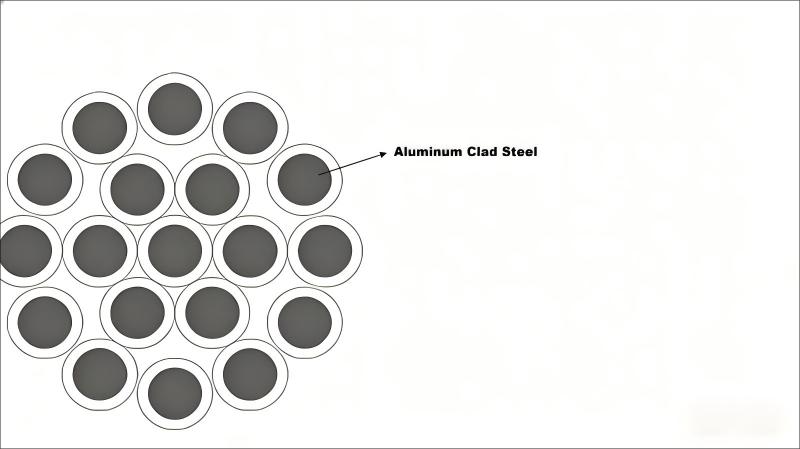
An ACS (Aluminum Clad Steel) conductor is a high-strength, composite overhead conductor. It consists of a central steel core that is coated with a thick, seamless layer of high-conductivity aluminum. This aluminum layer forms a permanent metallurgical bond with the steel, ensuring durability during installation. The aluminum cladding typically makes up at least 10% of the wire’s radius and about 25% of its cross-sectional area. The conductor is constructed by concentrically stranding these aluminum-clad steel wires.
ACS conductors are a popular choice for overhead applications, commonly used for overhead shield wires (static wires), as neutral messengers for low-voltage cables, and as a core in other conductors like ACSR. They combine the high tensile strength of steel with the superior corrosion resistance and conductivity of aluminum, making them ideal for demanding environments.
The full form of ACS conductor is Aluminum Clad Steel Conductor. It is also known as aluminum-coated steel conductor because the steel wire core is covered with a bonded aluminum layer. This construction combines the mechanical strength of steel with the corrosion resistance and conductivity of aluminum.
The primary difference between ACS (Aluminum Clad Steel) and ACSR (Aluminum Conductor Steel Reinforced) lies in their construction and the role of the steel.
ACS (Aluminum Clad Steel): This is a homogeneous conductor made entirely of aluminum-clad steel wires. Every strand in the conductor is composed of a steel core clad in aluminum. Its primary purpose is to offer a balance of strength and conductivity for applications like overhead ground wires.
ACSR (Aluminum Conductor Steel Reinforced): This is a composite conductor with a central core made of steel wires (often galvanized) for strength, surrounded by one or more layers of pure aluminum (EC grade 1350) or aluminum alloy strands for conductivity. The steel core and aluminum strands are distinct materials.
In essence, ACS is a wire where every strand is aluminum-clad steel, while ACSR is a composite of a steel core surrounded by pure aluminum strands. While ACSR offers high strength for long spans, ACS provides superior corrosion resistance as there is no exposed steel.
ACS conductors offer a compelling combination of advantages for overhead power lines:
High Strength-to-Weight Ratio: The steel core provides exceptional tensile strength, while the aluminum cladding reduces overall weight compared to a solid steel wire of similar strength. The tensile strength of ACS is about 8 times that of an aluminum wire of the same diameter.
Superior Corrosion Resistance: The aluminum cladding acts as a robust barrier, protecting the steel core from corrosion and rust. This makes ACS conductors highly effective in corrosive environments, such as coastal, industrial, and desert areas.
High Electrical Conductivity: The aluminum coating provides better conductivity than galvanized steel. ACS conductors are available in various conductivity grades, from 14% to 40% IACS.
Low Sag: ACS wires have a low coefficient of thermal expansion, which means they sag less when heated, reducing the need for extra supports.
Cost-Effectiveness: The use of a steel core with a thin aluminum layer is more economical than using pure aluminum, while also reducing shipping and installation costs.
The lifespan of an ACS conductor is significantly influenced by its environment. In severe coastal or industrial corrosive zones, the service life is estimated to be 5–15 years. However, due to its superior corrosion protection, ACS conductors generally offer a much longer lifespan in less aggressive environments. For context, ACSR conductors, which are similar in application, have been documented to have an expected life of around 40 years or more in coastal conditions, and up to 50-100 years in less severe environments when properly maintained. The aluminum cladding on ACS wires provides a substantial barrier that helps maintain mechanical characteristics over time, contributing to a longer operational life.