Product Description
AAC conductors are composed of hard-drawn aluminum wires, stranded in multiple concentric layers with alternating lay directions to enhance strength and flexibility.
Application
AAC(All-Aluminum Conductor) is widely used in power transmission lines across various voltage levels due to its excellent characteristics, including a simple structure, easy installation and maintenance, low cost, and high transmission capacity. It is particularly well-suited for installations that span rivers, valleys, or other areas with challenging geographical features. AAC is primarily used in electric distribution lines with shorter spans and lower mechanical stress. It is designed for continuous operation at temperatures of up to 75℃
Applicable Standard
IEC 61089, DIN 48201-5, AS 1531, BS 215-1, BS EN 50182, ASTM B231/B231M, and GB/T 1179.
Construction
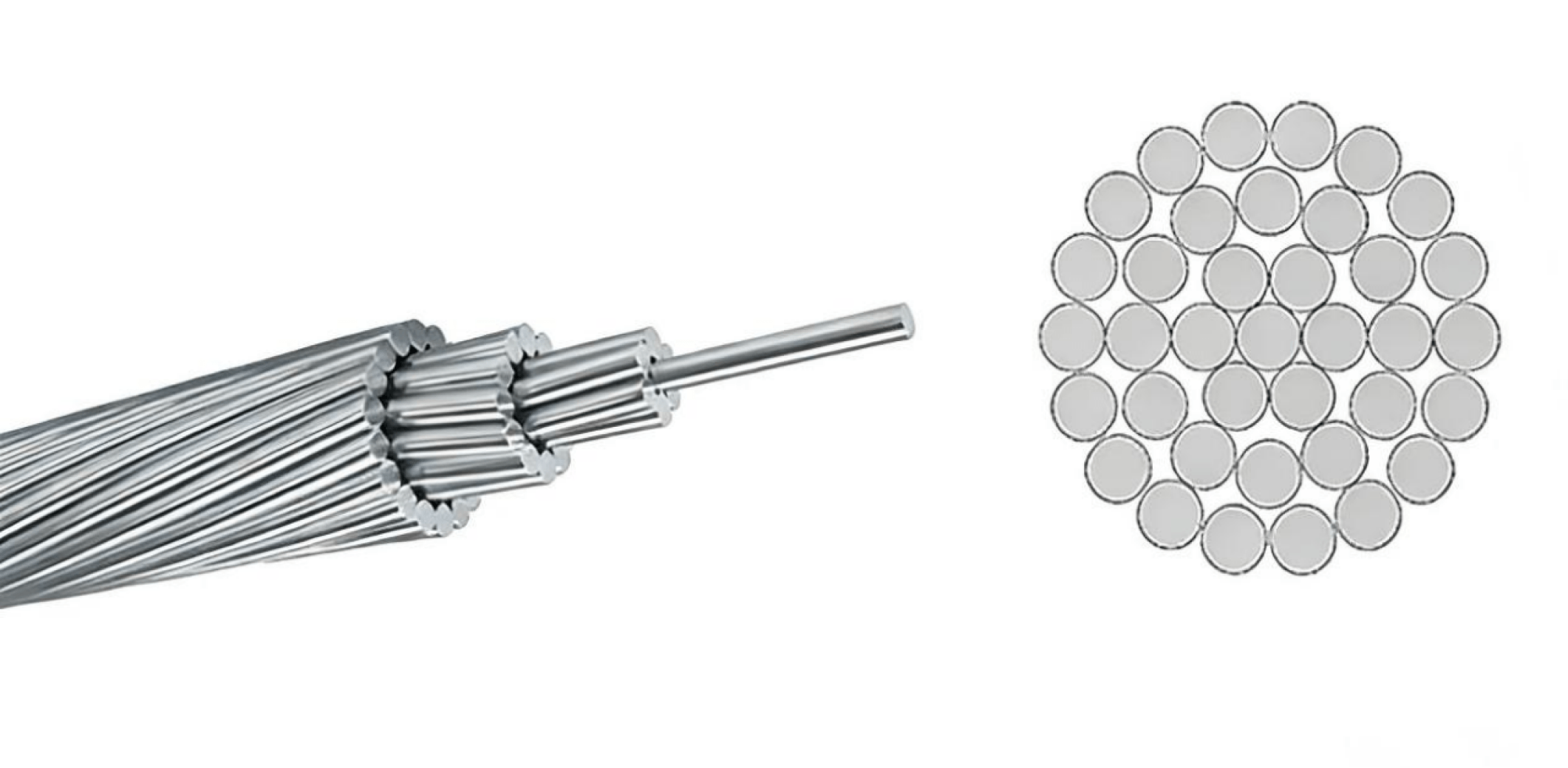
Technical Parameters
| Code Name |
Nominal Area |
No.&Dia.of Wire | Approx.Overall Dia. |
Approx. Weight |
Nominal Breaking Load |
Max.DC Resistance at 20℃ |
| mm2 | No./mm | mm | kg/km | kN | Ω/km | |
| 10 | 10.0 | 7/1.35 | 4.05 | 274 | 2.0 | 2.8633 |
| 16 | 16.0 | 7/1.71 | 5.13 | 43.8 | 3.0 | 1.7896 |
| 25 | 25.0 | 7/2.13 | 6.39 | 68.4 | 4.5 | 1.1453 |
| 40 | 40.0 | 7/2.70 | 8.10 | 109.4 | 6.8 | 0.7158 |
| 63 | 63.0 | 7/3.39 | 10.17 | 172.3 | 10.4 | 0.4545 |
| 100 | 100.0 | 19/2.59 | 12.95 | 274.8 | 17.0 | 0.2877 |
| 125 | 125.0 | 19/2.89 | 14.45 | 343.6 | 21.3 | 0.2302 |
| 160 | 160.0 | 19/3.27 | 16.35 | 439.8 | 26.4 | 0.1798 |
| 200 | 200.0 | 19/3.66 | 18.30 | 549.7 | 32.0 | 0.1439 |
| 250 | 250.0 | 19/4.09 | 20.45 | 687.1 | 40.0 | 0.1151 |
| 315 | 315.0 | 37/3.29 | 23.03 | 8679 | 52.0 | 0.0916 |
| 400 | 400.0 | 37/3.71 | 25.97 | 1102.0 | 64.0 | 0.0721 |
| 450 | 450.0 | 37/3.94 | 27.58 | 1239.8 | 72.0 | 0.0641 |
| 500 | 500.0 | 37/4.15 | 29.05 | 13776 | 80.0 | 0.0577 |
| 560 | 560.0 | 37/4.39 | 30.73 | 1542.9 | 89.6 | 0.0515 |
| 630 | 630.0 | 61/3.63 | 32.67 | 1738.3 | 100.8 | 0.0458 |
| 710 | 710.0 | 61/3.85 | 34.65 | 1959.1 | 113.6 | 0.0407 |
| 800 | 800.0 | 61/4.09 | 36.81 | 22074 | 128.0 | 0.0361 |
| 900 | 900.0 | 61/4.33 | 38.97 | 2483.3 | 144.0 | 0.0321 |
| 1000 | 1000.0 | 61/4.57 | 41.13 | 2759.2 | 160.0 | 0.0289 |
| 1120 | 1120.0 | 91/3.96 | 43.56 | 3093.5 | 179.2 | 0.0258 |
| 1250 | 1250.0 | 91/4.18 | 45.98 | 3452.6 | 200.0 | 0.0231 |
| 1400 | 1400.0 | 91/4.43 | 48.73 | 3866.9 | 224.0 | 0.0207 |
| 1500 | 1500.0 | 91/4.58 | 50.38 | 4143.1 | 240.0 | 0.0193 |
| Area | No.&Dia.of Wire | Approx.Overall Dia. |
Approx. Weight |
Nominal Breaking Load |
Max.DC Resistance at 20℃ |
|
| Nominal | Actual | |||||
| mm2 | mm2 | No./mm | mm | kg/km | kN | Ω/km |
| 16 | 15.9 | 7/1.70 | 5.10 | 43.0 | 2.8 | 1.8022 |
| 25 | 24.3 | 7/2.10 | 6.30 | 66.0 | 4.2 | 1.1810 |
| 35 | 34.4 | 7/2.50 | 750 | 94.0 | 5.8 | 0.8333 |
| 50 | 49.5 | 7/3.00 | 9.00 | 135.0 | 79 | 0.5787 |
| 50 | 48.4 | 19/1.80 | 9.00 | 133.0 | 8.5 | 0.5951 |
| 70 | 65.8 | 19/2.10 | 10.50 | 181.0 | 11.3 | 0.4372 |
| 95 | 93.3 | 19/2.50 | 12.50 | 256.0 | 15.7 | 0.3085 |
| 120 | 1170 | 19/2.80 | 14.00 | 322.0 | 18.8 | 0.2459 |
| 150 | 147.1 | 37/2.25 | 15.80 | 406.0 | 25.3 | 0.1960 |
| 185 | 181.6 | 37/2.50 | 17.50 | 500.0 | 30.5 | 0.1588 |
| 240 | 242.5 | 61/2.25 | 20.30 | 670.0 | 39.5 | 0.1191 |
| 300 | 299.4 | 61/2.50 | 22.50 | 8270 | 47.7 | 0.0965 |
| 400 | 400.1 | 61/2.89 | 26.00 | 1104.0 | 60.9 | 0.0722 |
| 500 | 499.8 | 61/3.23 | 29.10 | 1379.0 | 74.7 | 0.0578 |
| 625 | 626.2 | 91/2.96 | 32.60 | 1732.0 | 95.3 | 0.0462 |
| 800 | 802.1 | 91/3.35 | 36.90 | 2218.0 | 118.4 | 0.0360 |
| 1000 | 999.7 | 91/3.74 | 41.10 | 27670 | 145.8 | 0.0289 |
| Code Name |
Nominal Area |
No.&Dia.of Wire | Approx. Overall Dia. |
Approx. Weight |
Nominal Breaking Load |
Max.DC Resistance at 20℃ |
| mm2 | No./mm | mm | kg/km | kN | Ω/km | |
| Leo | 34.4 | 7/2.50 | 7.50 | 94.3 | 5.7 | 0.8330 |
| Leonids | 41.6 | 7/2.75 | 8.25 | 113.0 | 6.7 | 0.6890 |
| Libra | 49.5 | 7/3.00 | 9.00 | 135.0 | 8.0 | 0.5790 |
| Mars | 773 | 7/3.75 | 11.30 | 211.0 | 11.8 | 0.3700 |
| Mercury | 111.0 | 7/4.50 | 13.50 | 304.0 | 16.9 | 0.2580 |
| Moon | 124.0 | 7/4.75 | 14.30 | 339.0 | 18.9 | 0.2320 |
| Neptune | 158.0 | 19/3.25 | 16.30 | 433.0 | 24.7 | 0.1830 |
| Orion | 183.0 | 19/3.50 | 17.50 | 503.0 | 28.7 | 0.1570 |
| Pluto | 210.0 | 19/3.75 | 18.80 | 576.0 | 31.9 | 0.1370 |
| Saturn | 262.0 | 37/3.00 | 21.00 | 721.0 | 42.2 | 0.1100 |
| Sirius | 3070 | 37/3.25 | 22.80 | 845.0 | 48.2 | 0.0940 |
| Taurus | 3370 | 19/4.75 | 23.80 | 924.0 | 51.3 | 0.0857 |
| Triton | 409.0 | 37/3.75 | 26.30 | 1120.0 | 62.2 | 0.0706 |
| Uranus | 506.0 | 61/3.25 | 29.30 | 1400.0 | 75.2 | 0.0572 |
| Ursula | 5870 | 61/3.50 | 31.50 | 1620.0 | 873 | 0.0493 |
| Venus | 673.0 | 61/3.75 | 33.80 | 1860.0 | 972 | 0.0429 |
| Code Name |
Nominal Area |
No.&Dia.of Wire | Approx.Overall Dia. |
Total Area |
Approx. Weight |
Nominal Breaking Load |
Max.DC Resistance at 20℃ |
| mm2 | No./mm | mm | mm2 | kg/km | kN | Ω/km | |
| Midge | 22.0 | 7/2.06 | 6.18 | 23.3 | 64.0 | 4.0 | 1.2270 |
| Ant | 50.0 | 7/3.10 | 9.30 | 52.8 | 145.0 | 8.3 | 0.5419 |
| Fly | 60.0 | 7/3.40 | 10.20 | 63.6 | 174.0 | 9.9 | 0.4505 |
| Wasp | 100.0 | 7/4.39 | 13.17 | 106.0 | 290.0 | 16.0 | 0.2702 |
| Hornet | 150.0 | 19/3.25 | 16.25 | 1576 | 434.0 | 25.7 | 0.1825 |
| Chafer | 200.0 | 19/3.78 | 18.90 | 213.2 | 587.0 | 32.4 | 0.1349 |
| Cockroach | 250.0 | 19/4.22 | 21.10 | 265.7 | 731.0 | 40.4 | 0.1083 |
| Butterfly | 300.0 | 19/4.65 | 23.25 | 322.7 | 888.0 | 48.8 | 0.0892 |
| Centipede | 400.0 | 37/3.78 | 26.46 | 415.2 | 1145.0 | 63.1 | 0.0694 |
| Code Name |
No.&Dia.of Wire | Approx.Overall Dia. |
Total Area |
Approx. Weight |
Nominal Breaking Load |
Max.DC Resistance at 20℃ |
| No./mm | mm | mm2 | kg/km | kN | Ω/km | |
| Gnat | 7/2.21 | 6.63 | 26.9 | 73.0 | 4.8 | 1.0643 |
| Mosquito | 7/2.59 | 7.77 | 36.9 | 101.0 | 6.3 | 0.7749 |
| Ladybird | 7/2.79 | 8.37 | 42.8 | 117.0 | 73 | 0.6678 |
| Bluebottle | 7/3.66 | 10.98 | 73.6 | 201.0 | 11.8 | 0.3880 |
| Earwig | 7/3.78 | 11.34 | 78.6 | 215.0 | 12.6 | 0.3638 |
| Grasshopper | 7/3.91 | 11.73 | 84.1 | 230.0 | 13.5 | 0.3400 |
| Clegg | 7/4.17 | 12.51 | 95.6 | 261.0 | 15.3 | 0.2989 |
| Beetle | 19/2.67 | 13.35 | 106.4 | 292.0 | 18.1 | 0.2701 |
| Bee | 7/4.90 | 14.70 | 132 | 361.0 | 21.1 | 0.2165 |
| Caterpillar | 19/3.53 | 1765 | 185.9 | 511.0 | 29.8 | 0.1546 |
| Spider | 19/3.99 | 19.95 | 237.6 | 653.0 | 38.0 | 0.1210 |
| Moth | 19/5.00 | 25.00 | 373.1 | 1025.0 | 59.7 | 0.0770 |
| Drone | 37/3.58 | 25.06 | 372.4 | 1027.0 | 59.6 | 0.0774 |
| Maybug | 37/4.09 | 28.63 | 486.1 | 1341.0 | 778 | 0.0593 |
| Scorpion | 37/4.27 | 29.89 | 529.8 | 1461.0 | 84.8 | 0.0544 |
| Cicada | 37/4.65 | 32.55 | 628.3 | 1733.0 | 100.5 | 0.0459 |
| Code Name |
Nominal Area | No./Dia.of Wire | Approx.Overall Dia. |
Approx. Weight |
Nominal Breaking Load |
Max.DC Resistance at 20℃ |
|
| AWG or MCM | mm2 | No./mm | mm | kg/km | kN | Ω/km | |
| Peachbell | 6 | 13.3 | 7/1.56 | 4.68 | 36.6 | 2.5 | 2.1477 |
| Rose | 4 | 21.1 | 7/1.96 | 5.88 | 58.2 | 3.9 | 1.3606 |
| Iris | 2 | 33.6 | 7/2.47 | 741 | 92.6 | 6.0 | 0.8567 |
| Pansy | 1 | 42.4 | 7/2.78 | 8.34 | 116.6 | 73 | 0.6763 |
| Poppy | 1/0.0 | 53.5 | 7/3.12 | 9.36 | 1472 | 8.8 | 0.5369 |
| Aster | 2/0.0 | 674 | 7/3.50 | 10.50 | 185.7 | 11.1 | 0.4267 |
| Phlox | 3/0.0 | 85.0 | 7/3.93 | 11.79 | 233.9 | 13.5 | 0.3384 |
| Oxlip | 4/0.0 | 107.2 | 7/4.42 | 13.26 | 295.2 | 170 | 0.2675 |
| Valerian | 250.0 | 126.7 | 19/2.91 | 14.55 | 348.6 | 20.7 | 0.2274 |
| Sneezewort | 250.0 | 126.7 | 7/4.80 | 14.40 | 348.8 | 20.1 | 0.2269 |
| Laurel | 266.8 | 135.2 | 19/3.01 | 15.05 | 372.2 | 22.1 | 0.2125 |
| Daisy | 266.8 | 135.2 | 7/4.96 | 14.88 | 372.3 | 21.4 | 0.2125 |
| Peony | 300.0 | 152.0 | 19/3.19 | 15.95 | 418.3 | 24.3 | 0.1892 |
| Tulip | 336.4 | 170.5 | 19/3.38 | 16.90 | 469.5 | 273 | 0.1686 |
| Daffodil | 350.0 | 1773 | 19/3.45 | 17.25 | 4879 | 28.4 | 0.1618 |
| Canna | 397.5 | 201.4 | 19/3.67 | 18.35 | 554.9 | 31.6 | 0.1430 |
| Goldentuft | 450.0 | 228.0 | 19/3.91 | 19.55 | 6276 | 35.0 | 0.1260 |
| Syringa | 4770 | 241.7 | 37/2.88 | 20.16 | 664.8 | 38.6 | 0.1192 |
| Cosmos | 477.0 | 241.7 | 19/4.02 | 20.10 | 664.8 | 370 | 0.1192 |
| Hyacinth | 500.0 | 253.3 | 37/2.95 | 20.65 | 696.8 | 40.5 | 0.1136 |
| Zinnia | 500.0 | 253.3 | 19/4.12 | 20.60 | 6971 | 38.9 | 0.1134 |
| Dahlia | 556.5 | 282.0 | 19/4.35 | 21.75 | 775.8 | 43.3 | 0.1018 |
| Mistletoe | 556.5 | 282.0 | 37/3.12 | 21.84 | 775.7 | 44.3 | 0.1016 |
| Meadowsweet | 600.0 | 304.0 | 37/3.23 | 22.61 | 836.3 | 47.5 | 0.0948 |
| Orchid | 636.0 | 322.3 | 37/3.33 | 23.31 | 886.9 | 50.4 | 0.0892 |
| Heuchera | 650.0 | 329.4 | 37/3.37 | 23.59 | 9074 | 51.7 | 0.0871 |
| Flag | 700.0 | 354.7 | 61/2.72 | 24.48 | 975.8 | 57.1 | 0.0811 |
| Varbena | 700.0 | 354.7 | 37/3.49 | 24.43 | 975.7 | 55.4 | 0.0812 |
| Nasturtium | 715.5 | 362.6 | 61/2.75 | 24.75 | 998.5 | 58.4 | 0.0793 |
| Violet | 715.5 | 362.6 | 37/3.53 | 24.71 | 998.5 | 56.7 | 0.0794 |
| Cattail | 750.0 | 380.0 | 61/2.82 | 25.38 | 1046.0 | 60.3 | 0.0754 |
| Petunia | 750.0 | 380.0 | 37/3.62 | 25.34 | 1046.0 | 58.6 | 0.0755 |
| Lilac | 795.0 | 402.8 | 61/2.90 | 26.10 | 1110.0 | 63.8 | 0.0713 |
| Arbutus | 795.0 | 402.8 | 37/3.72 | 26.04 | 1109.0 | 61.8 | 0.0715 |
| Snapdragon | 900.0 | 456.0 | 61/3.09 | 2781 | 1256.0 | 70.8 | 0.0628 |
| Cockscomb | 900.0 | 456.0 | 37/3.96 | 2772 | 1256.0 | 68.4 | 0.0631 |
| Goldenrod | 954.0 | 483.4 | 61/3.18 | 28.62 | 1331.0 | 75.0 | 0.0593 |
| Magnolia | 954.0 | 483.4 | 37/4.08 | 28.56 | 1331.0 | 72.6 | 0.0594 |
| Camellia | 1000.0 | 506.7 | 61/3.25 | 29.25 | 1394.0 | 78.3 | 0.0568 |
| Magnolia | 954.0 | 483.4 | 37/4.08 | 28.56 | 1331.0 | 72.6 | 0.0594 |
| Camellia | 1000.0 | 506.7 | 61/3.25 | 29.25 | 1394.0 | 78.3 | 0.0568 |
| Hawkweed | 1000.0 | 506.7 | 37/4.18 | 29.26 | 1395.0 | 76.2 | 0.0566 |
| Larkspur | 1033.5 | 523.7 | 61/3.31 | 29.79 | 1442.0 | 81.3 | 0.0547 |
| Bluebell | 1033.5 | 523.7 | 37/4.25 | 29.75 | 1441.0 | 78.8 | 0.0547 |
| Marigold | 1113.0 | 564.0 | 61/3.43 | 30.87 | 1553.0 | 873 | 0.0510 |
| Hawthorn | 1192.5 | 604.2 | 61/3.55 | 31.95 | 1662.0 | 93.5 | 0.0476 |
| Narsissus | 1272.0 | 644.5 | 61/3.67 | 33.03 | 1774.0 | 98.1 | 0.0445 |
| Columbine | 1351.0 | 694.8 | 61/3.78 | 34.02 | 1884.0 | 104.0 | 0.0420 |
| Carnation | 1431.0 | 725.1 | 61/3.89 | 35.01 | 19970 | 108.0 | 0.0396 |
| Gladiolus | 1510.5 | 765.4 | 61/4.00 | 36.00 | 2108.0 | 114.0 | 0.0375 |
| Coreopsis | 1590.0 | 805.7 | 61/4.10 | 36.90 | 2216.0 | 120.0 | 0.0357 |
| Jassamine | 1750.0 | 886.7 | 61/4.30 | 38.70 | 2442.0 | 132.0 | 0.0324 |
| Cowslip | 2000.0 | 1013.0 | 91/3.77 | 41.47 | 27870 | 153.0 | 0.0286 |
| Sagebrush | 2250.0 | 1140.0 | 91/3.99 | 43.89 | 3166.0 | 167.0 | 0.0255 |
| Lupine | 2500.0 | 1267.0 | 91/4.21 | 46.31 | 3519.0 | 186.0 | 0.0229 |
| Bitterrot | 2750.0 | 1393.0 | 91/4.42 | 48.62 | 3872.0 | 205.0 | 0.0208 |
| Trillium | 3000.0 | 1520.0 | 127/3.90 | 50.70 | 4226.0 | 223.0 | 0.0193 |
| Bluebonnet | 3500.0 | 1773.0 | 127/4.22 | 54.86 | 49770 | 261.0 | 0.0165 |
FAQs
The fundamental difference lies in their construction and mechanical properties. AAC (All Aluminum Conductor) is composed solely of concentric-laid strands of EC-grade (1350) aluminum, making it a homogeneous, non-magnetic conductor. ACSR (Aluminum Conductor Steel Reinforced) features a central core of galvanized steel strands, surrounded by outer layers of aluminum strands. Because of this steel core, ACSR possesses significantly higher tensile strength, making it suitable for long spans, river crossings, and heavy ice loads. AAC offers better corrosion resistance (as no bi-metallic contact exists) and excellent conductivity, but its lower mechanical strength restricts it to shorter spans, such as urban distribution networks. ACSR is the stronger workhorse for extra-high-voltage transmission, while AAC is the corrosion-resistant, simpler choice for lower-tension distribution.
The standard maximum continuous operating temperature for an AAC conductor is 75°C (167°F) according to international standards such as IEC 61089 and ASTM B231.
Under emergency or short-circuit conditions, short-term operation up to 100°C may be permitted for brief intervals. Continuously operating above 75°C causes thermal annealing (softening) of the hard-drawn aluminum strands, permanently reducing mechanical tensile strength and causing excessive line sag.
AAC (All Aluminum Conductor) is primarily used for urban overhead electricity distribution networks where span distances are short and pole supports are closely spaced.
It is also widely specified for:
Residential secondary service drops.
Flexible busbar connections inside electrical substations.
Industrial facility distribution feeders requiring high current capacity and corrosion resistance without high tensile load demands.
Under standard operating conditions, the expected service lifespan of an AAC conductor is typically 30 to 50 years.
Because AAC consists entirely of homogenous aluminum strands, it is completely immune to the internal galvanic corrosion that can degrade steel-reinforced conductors. Proper stringing, installation with preformed armor rods, and avoiding thermal overloading ensure maximum service longevity.
Aluminum is preferred over copper for overhead lines primarily due to weight, cost, and structural economy:
Weight-to-Conductivity Efficiency: Although copper has higher volumetric conductivity, aluminum offers twice the electrical conductivity of copper per unit weight. AAC weighs about half as much as an equivalent copper conductor.
Cost Savings: Aluminum raw material costs are significantly lower than copper, drastically reducing total project material investment.
Lower Infrastructure Load: Lighter conductors put less mechanical strain on utility poles and towers, enabling lower installation and structural costs.