Product Description
Our series of 1120 Aluminium Alloy Conductors is manufactured in strict accordance with the AS/NZS 1531 standard, specifically engineered as high-strength All Aluminium Alloy Conductors (AAAC) for modern power transmission and distribution networks.
Application
Designed for longer spans and higher tension applications, AAAC conductors are widely used in urban, coastal, and industrial areas due to their excellent resistance to corrosion and lower sag under load. The enhanced strength-to-weight ratio allows for more efficient tower design and reduced line losses.
Applicable Standard
AS/NZS 1531
Construction
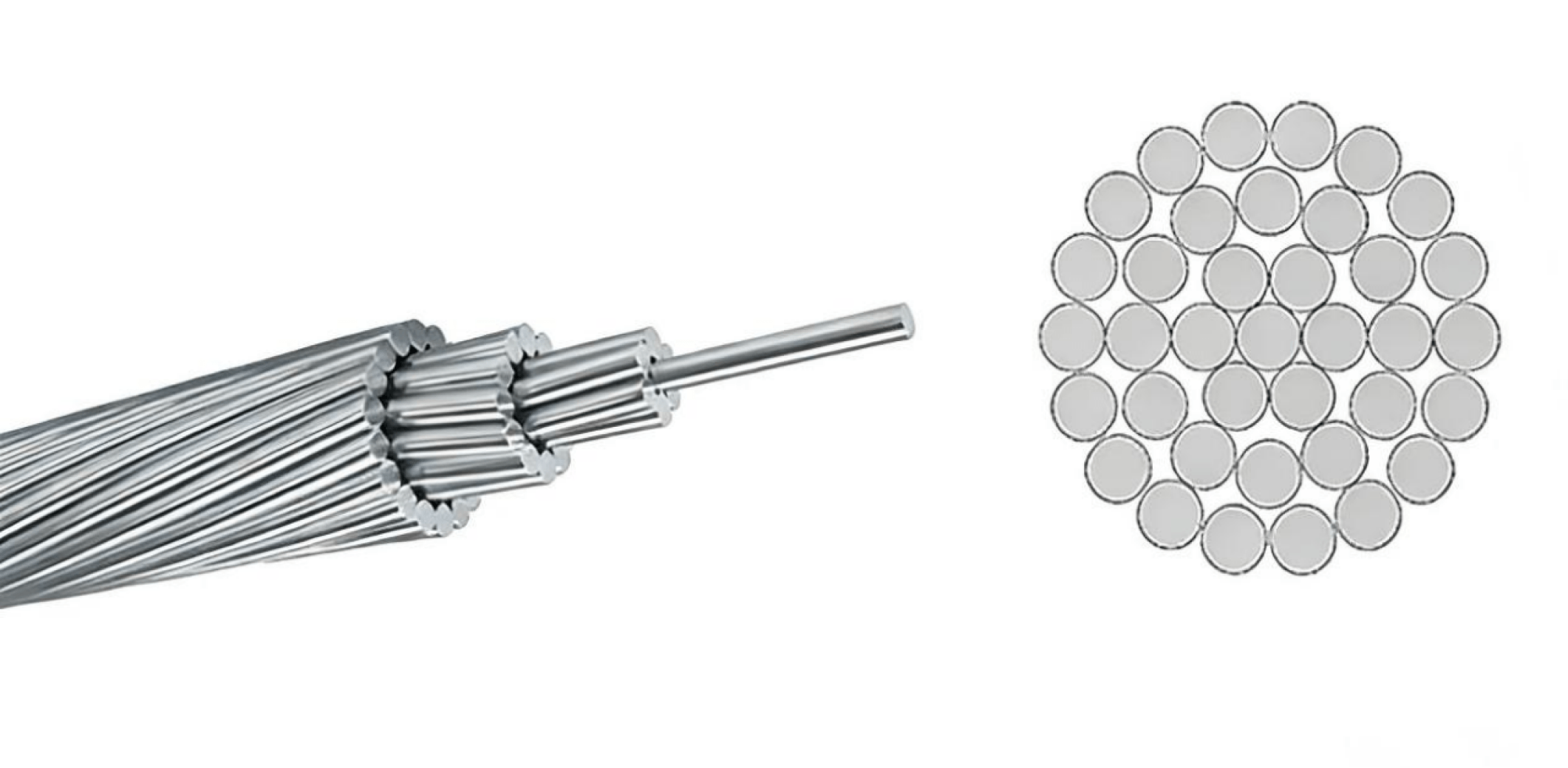
In general, the AAAC 1120 Conductor is constructed in the following manner:
Technical Parameters
| Conductor Code | Stranding and Wire Diameter |
Nominal Overall Diameter |
Cross Sectional Area |
Approximate Weight | Minimum Breaking Load |
Modulus of Elasticity |
Coefficient of Linear Expansion |
| No/mm | mm | mm² | kg/km | kN | GPa | x10-6/℃ | |
| Chlorine | 7/2.50 | 7.50 | 34.4 | 94.3 | 8.18 | 65 | 23.0 |
| Chromium | 7/2.75 | 8.25 | 41.6 | 113 | 9.91 | 65 | 23.0 |
| Fluorine | 7/3.00 | 9.00 | 49.5 | 135 | 11.8 | 65 | 23.0 |
| Helium | 7/3.75 | 11.3 | 77.3 | 211 | 17.6 | 65 | 23.0 |
| Hydrogen | 7/4.50 | 13.5 | 111 | 304 | 24.3 | 65 | 23.0 |
| Iodine | 7/4.75 | 14.3 | 124 | 339 | 27.1 | 65 | 23.0 |
| Krypton | 19/3.25 | 16.3 | 158 | 433 | 37.4 | 65 | 23.0 |
| Lutetium | 19/3.50 | 17.5 | 183 | 503 | 41.7 | 65 | 23.0 |
| Neon | 19/3.75 | 18.8 | 210 | 576 | 47.8 | 65 | 23.0 |
| Nitrogen | 37/3.00 | 21.0 | 262 | 721 | 62.2 | 64 | 23.0 |
| Nobelium | 37/3.25 | 22.8 | 307 | 845 | 72.8 | 64 | 23.0 |
| Oxygen | 19/4.75 | 23.8 | 337 | 924 | 73.6 | 65 | 23.0 |
| Phosphorus | 37/3.75 | 26.3 | 409 | 1120 | 93.1 | 64 | 23.0 |
| Selenium | 61/3.25 | 29.3 | 506 | 1400 | 114 | 64 | 23.0 |
| Silicon | 61/3.50 | 31.5 | 587 | 1620 | 127 | 64 | 23.0 |
| Sulfur | 61/3.75 | 33.8 | 673 | 1860 | 145 | 64 | 23.0 |
FAQs
AAAC (All Aluminum Alloy Conductor) is a bare overhead conductor made from high-strength aluminum alloy wires, typically 6201-T81, stranded in concentric layers.
Its superiority lies in being a “balanced solution” that offers a higher strength-to-weight ratio than AAC, better corrosion resistance than ACSR (as it has no steel core to rust), and lower power losses by eliminating the inductive effect of a steel core. It combines comparable strength and current capacity to ACSR with lighter weight and superior sag characteristics.
Key physical and electrical properties of AAAC conductors include:
High Tensile Strength: Typically ranges from 295 MPa to 330 MPa (for 6201 alloy), enabling long span distances.
Electrical Conductivity: Approximately 52.5% to 53% IACS (International Annealed Copper Standard).
Low Density: Around 2.70 g/cm³, making it much lighter than ACSR of equivalent outer diameter.
Corrosion Resistance: Excellent resistance to salt spray, humidity, and atmospheric pollutants.
Non-Magnetic: Prevents magnetic hysteresis energy losses during AC power transmission.
The standard maximum continuous operating temperature for AAAC conductors is 75°C to 85°C (167°F to 185°F) under standard IEC 61089 and ASTM B399 specifications.
In emergency overload conditions, short-term operation up to 90°C (194°F) may be permitted depending on line design. Exceeding these thermal thresholds for prolonged periods causes thermal softening (annealing) of the alloy, permanently compromising mechanical tensile strength.
The B2B wholesale price for AAAC conductors generally ranges from $2.40 to $3.80 USD per kg, depending on live market conditions.
Because pricing is directly tied to London Metal Exchange (LME) aluminum spot rates, exact quotes vary based on:
Alloy Type: AAAC 6201 vs. AAAC 1120.
Order Volume: Total metric tonnage and reel packaging specifications (wooden or steel drums).
Standard Compliance: ASTM B399, IEC 61089, or BS EN 50182 requirements.
Request a Live Quote: Contact our sales engineering team today with your target specifications to receive a factory-direct FOB/CIF price within 24 hours!
AAAC conductors are primarily utilized in:
Coastal and Marine Zones: Overhead distribution lines exposed to high salt spray and atmospheric humidity.
Industrial Corridors: Areas with heavy chemical pollution where steel-reinforced conductors suffer rapid corrosion.
Medium & High-Voltage Grids: Distribution and transmission spans requiring a balance of light weight, low sag, and high ampacity.
Substation Busbars: Overhead connections requiring non-magnetic properties.